John Murphy
The Mystery of The Invisible DogJohn Murphy is the stockbroker who turns the trust attached to his respectable life into cover for theft: as Harley Johnson’s guardian, he takes money from Harley’s account, loses it in stock-market speculation, and then steals the Carpathian Hound in an attempt to replace it. His scheme links the neighborhood burglary, a staged apartment fire, and a ransom demand, but the same daily routines that seem to protect him also expose him.
Identity and Introduction
Murphy first appears as a hearty, robust-looking man in a beige sweater, striding up the flagstone stairs while police search the neighborhood after a burglary. He sees Fenton Prentice sitting there with Bob Andrews and Pete Crenshaw and asks whether anything is the matter. Prentice gives him a bland explanation: there has been a burglary nearby, and the police are searching. At this point, Murphy is presented as a passing neighbor rather than a suspect.
His ordinary schedule helps define that appearance. Murphy has a corner apartment at the back of the building and works early because the stock market opens early in New York, three hours ahead of Los Angeles. Prentice says Murphy may be home any time after noon. The details make him seem legible through his occupation and timetable, while later becoming part of the pattern the investigators must interpret.
Family and Financial Motive
Murphy is Harley Johnson’s uncle and guardian; the college student is staying with him. That guardianship gives Murphy access to Harley’s money, and his crime begins with an abuse of that entrusted position. He borrowed from Harley’s account to fund his own stock-market speculations, lost all of it, and faced a deadline: Harley would come of age the following month, when Murphy would have to explain the missing funds. The $10,000 ransom was meant to restore the account before that reckoning.
The motive makes the theft more than a sudden attempt to obtain cash. Murphy tries to solve a financial crisis he created by committing another crime, and the person whose money he misused is also the nephew whose trust and future he is responsible for protecting. Harley responds with disapproval when Murphy is in hospital, and later forgives him; forgiveness, however, cannot settle the matter, which is left to the courts.
The Burglary and the Hidden Hound
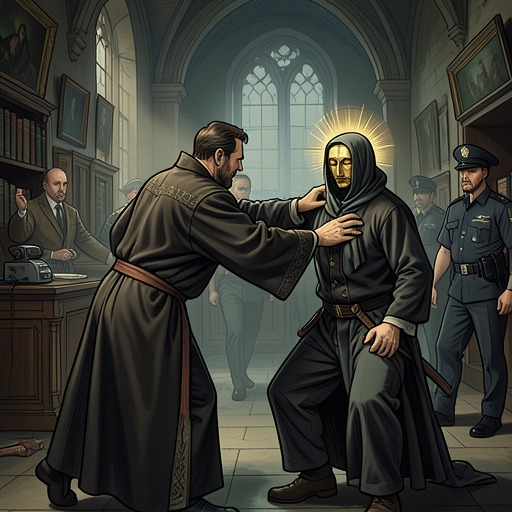
The investigation gradually places Murphy within the burglary’s chain of concealment. Jupiter Jones explains that the burglar, pursued by police, ducked into St Jude’s Church and disguised himself in a cape and mitre as a statue. When the caretaker’s return threatened to reveal the imposture, the burglar had reason to escape. The apparent hiding place was therefore also a means of moving through the search without being recognized.
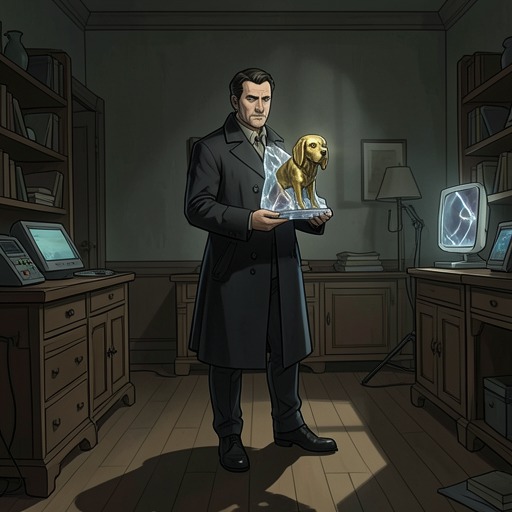
Murphy’s handling of the stolen sculpture shows the same preference for concealment in an ordinary setting. The Carpathian Hound was lowered into the apartment building’s pool on a length of gilt cord and released at the bottom. Against the blue-and-gold tiles, the cord disappeared into the pool’s pattern; the burglar did not need to enter the water to hide the object. The concealed sculpture was eventually recovered by Jupiter, whose explanation makes the seemingly unlikely hiding place a practical use of the building’s familiar surroundings.
The Fire and the Hospital Alibi
Murphy’s next apparent misfortune is a fire in his apartment. The fire captain initially describes the familiar accident of someone falling asleep with a lit cigarette: it drops onto the sofa, smoulders, and sets the curtains alight. The captain holds up the half-burned cigarette, wet with extinguisher foam. Sonny Elmquist has noticed the fire in time to save Murphy, who is still barefoot and very pale; the captain remarks that the real Christmas tree could have made the flames spread through the apartment in a minute.
Murphy is taken to hospital and calls for his nephew. Later, in a large corner room with sunlight coming through two windows, he lies pale against the pillow while Harley sits at the foot of the bed, looking at him with amusement and disapproval. Murphy glares at Jupiter Jones and resists being lectured; Harley points out the irony of the smoking habit. The hospital setting appears to put Murphy beyond suspicion, but Jupiter identifies the fire as deliberate: Murphy was not badly hurt and had set it himself to obtain a reason to be in hospital.
The choice of a private hospital supplies the alibi’s practical advantage. During the interval between Christmas and New Year, there would be few patients, and Murphy could learn the nurses’ routines and slip in and out while staff assumed he was resting. The supposed accident thus functions as both an excuse for his presence and cover for his movements. The half-burned cigarette that seemed to explain the fire instead belongs to the deception that made his hospital stay credible.
Exposure and Consequences
The ransom arrangements provide a further distinction between Murphy and another possible suspect, Alex Hassell, who feeds neighborhood cats every evening at five. The demand directs that the money be left in a park waste-paper bin at exactly that hour. Jupiter reasons that Hassell, whose absence would be noticed when the cats gathered, would not have chosen the time associated with his daily obligation. The schedule that might initially have implicated the cat-feeder instead points away from him and helps identify Murphy.
At the hospital, Jupiter’s final evidence is physical as well as circumstantial. The wrapped parcel is still sealed in a closet, and Murphy’s hands have been treated with special investigative ointment that will soon leave black spots. Even if he had disposed of the parcel, the marks would still connect him to it. Sergeant Henderson begins to state Murphy’s rights, but Murphy says he knows them, will get dressed, and wants to call his lawyer. The apparent invalid, the respectable broker, and the careful guardian are now exposed as the same man behind the crimes.
Murphy’s unraveling is driven by the very arrangements meant to shield him: the guardian’s access to Harley’s account creates the motive, a predictable routine helps distinguish the real culprit, and an invented emergency turns the hospital into a temporary refuge rather than a secure alibi. Harley’s forgiveness offers a personal response, but it does not erase the financial betrayal or decide the legal consequences. Murphy’s final position is therefore unresolved in judgment, but no longer in identity: the investigators have made his concealment visible.